“Let us loop you in”, the event hosted by Apple on today, March 21st brought some great news, affirmations and a few gut punches.
Here’s what you need to know:
Who steps on stage first? You guessed it, our buddy Tim Cook who started off the day with an introduction and words of affirmation letting us know that our iPhones are personal, private devices that Apple will be committed to keeping it that way. Cook noted, “owes it to our customers and we owe it to our country”, furthermore nothing, “This is an issue that impacts all of us, and we will not shrink from this responsibility.” For those of you following the Apple v FBI case, this is certainly something you want to hear and should be proud to hear from Apple’s CEO, he knows how pivotal our devices are in our daily lives.
Apple Renew
Since there are so many iPhones in use all over the world, as well as many other smartphones, there is no real standard of recycling them. In comes, Apple Renew where project “Liam” will automatically disassemble old iPhone components for potential re-use in an effort to reduce waste.
Apple Watch
Apple is giving us new bands made of woven nylon and dropping the price down to $299 for the entry level Apple Watch Sport device. This will put it on par with the Moto 360 2nd generation, which is highly regarding as the best option for Android Wear.
Apple TV
With the Apple TV currently having support for over 5000 focused apps, there comes a need for a few additional features:
Folders for app grouping just like on iPhone and iPad
Voice dictation throughout the OS (entering text and more)
Access iCloud Photo library on tvOS
iPhone
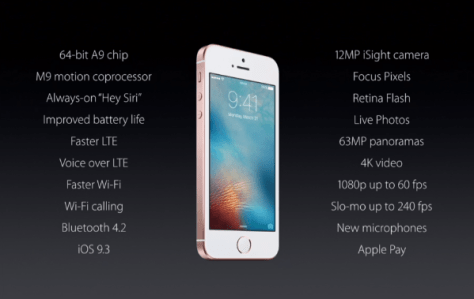
iPhone SE, something we all knew about, has finally showed it’s 4-inch face today. This device is essentially the iPhone 6S in a smaller body. The device will include the A9 processor, M9 chip for the always-on “Hey Siri”, NFC and Live Photo support. This is followed up with a flurry of updates coming in the form of iOS 9.3 which includes:
Nightshift
Notes protection
Health app upgrades
More education focused apps for the classroom
iPad
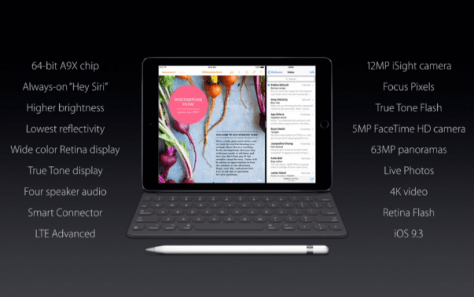
iPad Pro has given users a pencil with enhanced drawing capabilities that replicate drawing using an actual pencil and paper; however, some feel that the iPad Pro coming in at 12.9 inches a little to unwieldy. This has sparked the created of a 9.7-inch iPad Pro model starting out at $599 that is easier to hold, carry and work with and should provide a boost in sales to the line. This new device also pushes the price drop of the iPad Air 2, which will now start at $399.
Bottom line and takeaways: Incremental; yet, focused and much needed upgrades and product introductions. The iPhone is now available in a flavor for everyone in a very classy move by bringing back the 4-inch form factor and bringing the specs up to 2016 standards. While I feel like 4 inches is entirely too small for a device, some love it. Apple is also touting the iPad pro as a PC replacement (which is a bold statement that I believe is reaching a bit), is this now possible in 2016? Many feel that the tablet is a companion device that should stay in it’s place — we will see how this plays out.
iPhones, Galaxies, G4s, Xperias, Lumias, Moto — those are just a few of the names that you hear when it comes to that time of year for you to consider buying a new smartphone. First things first, let’s clear the air and recognize that Android 6.0 and iOS 9.2 will get you to the same destination, one may require more or less clicks, one may look better or worse and one may look the same or widely different depending on the device but the end result is the same.
Now that that is out of the way, let’s break down the important components of a smartphone purchasing decision:
Amount of money that you are willing to spend, Price.
Ecosystem preference.
Peripheral preference. (things like USB, lightning, etc.)
3rd party support.
Power user or simple user.
Price
Apple puts iOS on devices that they build — that’s it; so, in a nutshell, one must conform to their prices and they can get expensive. One thing to note is that Apple focuses on really marrying the software and hardware together to create one of the finest smartphone experiences that money can buy. When it comes to Android devices, prices fluctuate all over the place from the biggest flagships such as the Galaxy S6, Galaxy Note 5, HTC One M9 and more you will pay top dollar. However, there are mid-range devices that can sometimes give users just as good performance without completely emptying out your pocketbook.
One important note, do NOT buy a cheap Android device (something less than $250 or something sold in Walmart) then complain to all of your friends that Android is not a great operating system. The problem here is that you as a buyer, made a poor decision when buying your device (find another tech site willing to share that truth with you).
Quality and performance come at a price.
Ecosystem Preference
Some of us have large iTunes libraries with music going back to the days of the first iPod, while others cannot live without GMail, Google Keep, then you have others that simply need the embeded support of Microsoft’s suite of apps — everyone is different. With that being said,the Apple App Store and Google Play Store largely have the same apps and games; however, please expect most apps to be developed and arrive first on the Apple App Store. This is not due to an embedded hatred for Android it is due to the sheer number of devices that a developer has to account for when creating an app, versus iOS being on similar hardware at all times. One thing to note here is that Google typically makes all it’s it’s services available on multiple platforms while Apple does not — with the exception of Apple Music appearing in the Google Play Store.
The Windows Store is really missing key apps though, examples are Instagram, Google Chrome and more — this shows that developer support as well as user support really is not there.
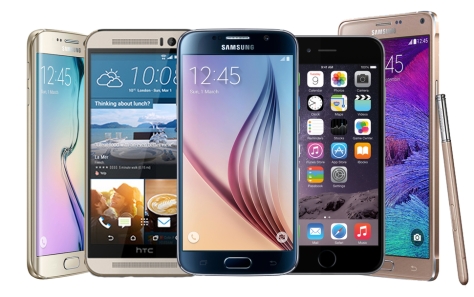
Popular smartphones from 2015.
Peripheral Preference
USB is an industry standard. Standards are good and are largely used and promoted by more open companies such as Google. Apple, although screaming of quality, locks the user in here with a lone lightning port on the device alongside a 3.5 mm headphone jack. Chargers and charging cables cannot be shared with anything that is not an Apple device.
Third Party Support
Literally everything you see from third parties are made to support Apple’s latest and greatest flagship device. As noted above, this does not happen because OEMs dislike Android or Google, it is because iOS is only on a select group of devices, while Android phones and tablets can come from literally any OEM that gets the required certification from Google and others who do not. Meaning, it is simply easier to adapt or provide an interface from an iOS device rather than account for each and every smartphone running Android.
Power user or Simple User
While some power users enjoy iOS, for those of you who love to tinker and have control of literally every part of your smartphone — the choice is simple, go with an Android device. However, with great power also comes great responsibility. Having an open platform means that you as the user could change a setting that leaves your device running a bit slower or even a bit faster. One can setup the homescreen in any manner that they like in addition to even creating custom gestures and assigning actions.
If you like to take the simple approach to a smartphone, you really don’t care about customizations other than a case and just want your device to work day in and day out — the choice is clear, go with an iOS device. The way that iOS and Android are built are fundamentally different and that is key here because apps only interact with so many layers of the operating system, which makes some apps somewhat limited; yet, this focuses in on providing a clean, consistent and sometimes less cumbersome experience.
Conclusion: The choice is yours! Do you have an unlimited bank account, do you like to trick out your homescreens or would you rather be consistent and reliable.
Two great ways to reach the same destination, just choose your ride!
What is a memory leak you ask? Here is the definition from Wikipedia: In computer science, a memory leak is a type of resource leak that occurs when a computer program incorrectly manages memory allocations in such a way that memory which is no longer needed is not released.
Google, why hasn’t this been fixed? It has been over 1 1/2 years since a memory leak was introduced in Lollipop, Android 5.X. Why is it still in the latest and greatest version of Android Marshmallow, which is 6.0?
What can a memory leak do to your Android device? From making it virtually unusable, it can also make it slow and very sluggish, which would force the end user to restart the device to ultimately correct the processes that are not correctly releasing memory back to the operating system. This is a very frustrating process because it occurs without any warning. Let’s face it, even with Android devices being made with 3/4GB of RAM, the OS still utilizes over 80% at any given time, which is good; however, the problem lies when the device gets down to it’s last couple of hundred of megabytes and processes are gasping for more memory that they will never get. Memory on Android is a very confusing topic and I suggest that you do your own research on it; however, to briefly outline it:
Android automatically manages memory while your apps are running
There is no need, ever, for a Task Killer
Apps come into memory, grab the resources that they need
When an app is closed and is left unused for some time that memory will be released and be available to the operating system again
The important thing to note about all of these above steps that happen at the operating system level is that they should happen automatically.
It isn’t and it needs to be addressed now. A very poor user experience is achieved when a user has to restart a device in order to get it to work properly.
The time finally came for me to put my Android device down, take out the SIM card and insert it into a freshly purchased Apple iPhone 5s.
Was I nervous, afraid and think that I’d hate it? Yes.
Did any of those feelings last longer than one day? No.
Enter iPhone 5s, let’s get started!
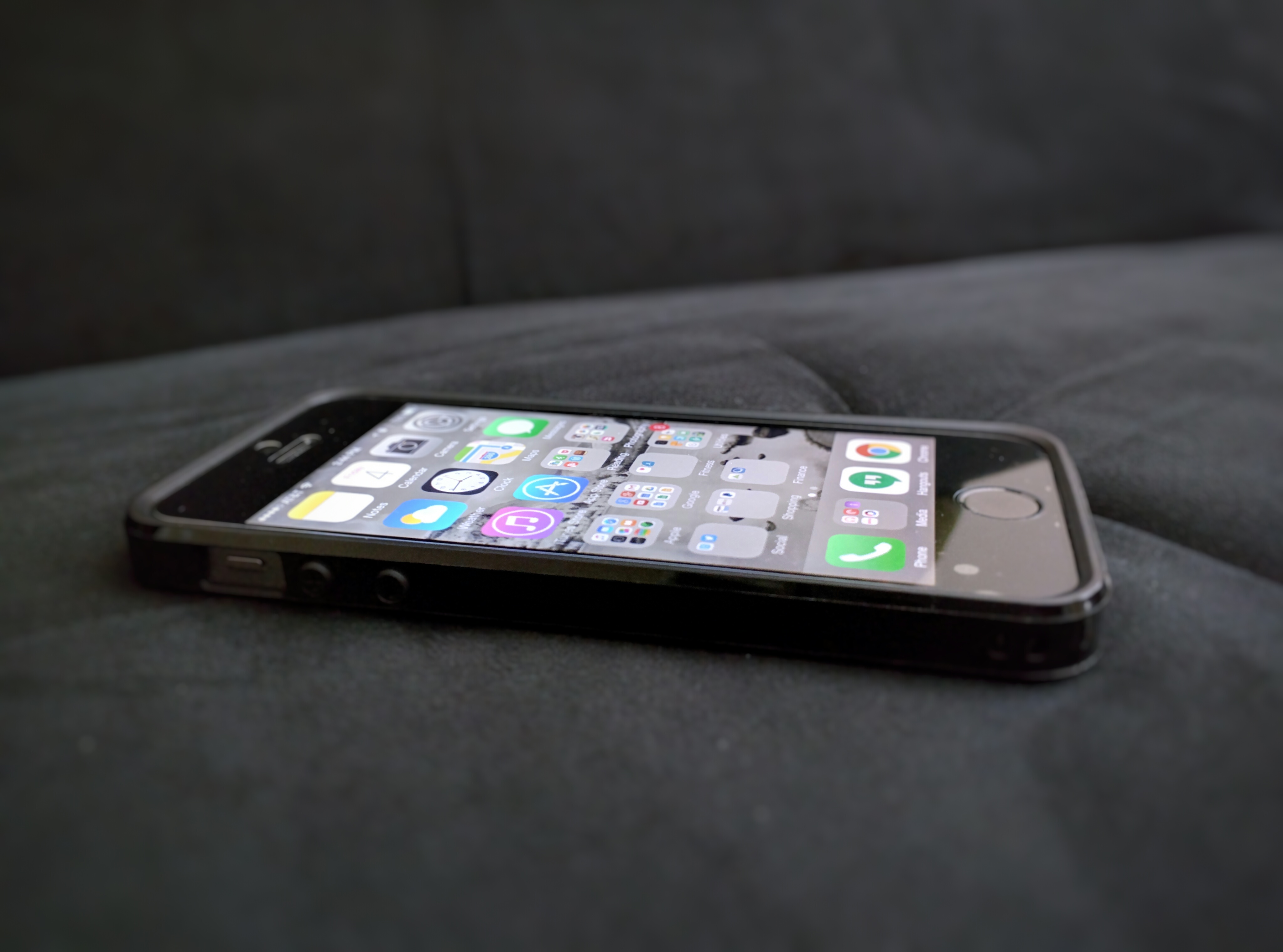
iPhone 5S.
A test, especially when you are trying to dive into a completely different world (iOS rather than Android) is nothing that should be taken lightly, can be daunting and should be of an adequate length of time to fully immerse yourself into the device and it’s ecosystem. This was a test of 7 days with certain parameters to ensure that I was fully in iOS as much of the time as I could be:
No going back to Android (Explanation: If there was an action that I could do easily with an Android smartphone, I was not allowed to do so — I had to figure out how it could be done on iOS or simply do without).
Must use the device as my “daily driver” for 7 complete days.
Cannot carry my Android device of choice (Moto Nexus 6) around as a backup.
Let the games begin!
One of the first things that you will notice about an Apple device is its attention to detail, just how well the device is constructed and trying to follow that “it just works” flow with the apps that are built in. And I must say, the apps that are bundled with the iPhone work well and are very consistent. Setting up security during the initial setup was painless with PIN to lock as well as Touch-ID, which is absolutely phenomenal (more on that later). After this initial phase, it was time to get down and dirty and install some of my favorite apps. Being someone who pays attention to iOS, apps and all major device releases, at this point we all know that the apps that matter are on all of the mobile ecosystems — so there was no hassle in finding the same apps that I had on my Nexus 6, in addition to a few other iPhone exclusives, to put on my new device. There were the must have apps: Pocketcasts, Gmail, Google, Google Photos, Hangouts (because I use Google Voice exclusively), Chrome and a few more that had to be installed first — this was all done during the night before that day that I was to begin using the device as my daily driver.
Fast forward to day number one. I unplugged the iPhone from it’s charger and didn’t really know what to expect during my day; however, there were a few things, that just in day one I noticed within hours.
TouchID is phenomenal. Apple truly got something 100% correct here, which is why this feature has been duplicated, some not as well, in other devices that are on the market today. Using ID to unlock your device is almost instantaneous it is so fast. In addition, many apps that implement security features, such as PIN numbers to access Credit Karma, allow TouchID to be your method of sign in, which is just further eliminating tapping away incessantly on the keyboard. Way to go Apple, way to go.
The App Store is really bad. I will not go so far as to say it is horrible, but it is really bad. Why?
App discovery is almost non existent here, it seems that the App Store is just overrun with games instead of apps to help make your life easier and while those are there you have to shuffle through the likes of Dungeon Boss and Minecraft to get to them.
Why are there two stores in iOS? You have the iTunes Store and the App Store. If everything was compiled into one convenient location it seems that it would make it easier on the user to go to a one stop shop.
Text is incredibly clear not only indoors but outdoors as well with direct sunlight.
Consistency throughout. Every app, regardless of how powerful you think it may be, launches in the same amount of time and it is simply refreshing. Not only do they launch at the same rate, but you get back to the homescreen (or initiating folder) at the same rate. Some might view this as boring (which, admittedly, it kind of is) but it is also very consistent. Consistency is key here when talking about iOS, it is certainly the most consistent mobile OS experience that I have had to date for these reasons. Let’s have a look at an example, shall we? There are a few notoriously bad apps in Android that seem to take their sweet time opening, while at times they are instant others leave you wondering is the app just in a bad mood today. (Here is an odd fact, these are all Google apps and they perform and look better on iOS)
Google Play Music on iOS just opens and I hate to use that “just works” mantra here, but it does. I did several performance tests here to validate my findings. I grabbed my Nexus 6 and opened the app the same time and about 7/10 the iPhone would somehow always win; however, the iPhone does not handle this app better because it opens quicker, it handles this app better because it consistently opens and closes the app at the same rate, regardless if it is being switched from or into or started fresh after swiping the card away.
YouTube on Android (to put it blatantly) has sucked for a long time, the app truly had a mind of it’s own when opening and speed was something that surely wasn’t a focal point. This has largely been fixed now; however, it still hiccups at times (which happens in every mobile OS, even iOS — more on that later). I performed the same test that I performed with Google Play Music and the results were the same; however, YouTube is not the offender that it used to be on Android.
Going back. Back buttons and back actions exist all over the mobile sphere. But does Apple get it right? Partly yes and it has nothing to do with a hardware button since the only button on the device that actually manipulates your position in the OS is home. So although Apple doesn’t have the physical back button here or on screen, developers do an excellent job at providing that navigation in the app and the experience is nothing short of spectacular. One swipe to the right, in most apps, will return you to the previous screen consistently and there isn’t much learning that needs to be done to recognize this.
Notifications are a pure afterthought in the grand scheme of things. You’d have to be pretty blind in Apple love to miss the fact that notifications were never meant to be focal point in iOS; however, this is essentially by design. Notifications come in through the Notifications tab in the pull down menu and they might as well stay there with as many swipes and taps that it takes for you to remove them! Clear all, please. Please.
Although the latest version of iOS (8.4.1) allows for probably the most amount of customization and sharing you are still limited here. I will simply say that I tried to share a picture and failed miserably. Sending a simple photo to my wife resulted in failure, so much that I just said forget it. In this case, I wanted to share a picture from Google Photos to Hangouts, which is my primary messenger since I use Google Voice; however, the share was not allowed. I was pleasantly surprised to see that I could share to another number of apps, such as GroupMe; however, you would think that as a messaging app it would allow shares to be initiated between the two regardless. (It is difficult to tell if this is Hangouts issue or if it’s an Apple issue, we can call it 50/50 for now. More on this later.).
Day to day interactions throughout the week continued smoothly. I was honestly very surprised that I was not reaching for my trusted Nexus 6 more over these past few days; but for the most part I did not need to. My apps experience on iOS has been very good, except for a few hiccups that resulted in an Apple screen during the update process of a few apps, even a few dropped frames here and there (as I stated before, every mobile OS has hiccups, this is something that some iPhone users probably do not want to admit). Otherwise, I have been flipping through apps like a pro and honestly trying to see just how smooth transitions can be when going back and forth between apps and you could probably guess how these tests went? Smooth, consistent and all resulting in a great end-user experience. Throughout installing app after app I was wondering if this would have a negative affect on battery life; however, it has been nothing short of stellar, as I am typing this my iPhone is currently sitting at a comfortable 67% battery remaining. Speaking of battery life, I cannot forget to mention that standby time is better than any device I’ve ever touched. If you take this phone off of the charger at 100% and leave it alone, you will return hours later to see it either on the same percentage or very close. Hopefully, these types of battery issues for Android are fixed in the 6.0, Marshmallow, update. One thing to note, is that it doesn’t seem like one app can kill and bog down your entire system in ways that Android apps are prone to do due to bad coding and this is likely due to the sandbox that you are placed in when using iOS which in this case is a great thing because Apple is controlling the user experience; however as noted above, controlling the UX can be a bad thing when sharing a simple picture fails. Google’s apps on are iOS are nothing short of gorgeous and one irritating part about each app is that it honestly performs better than it’s Android counterpart with the exception of GMail and Google Drive and it’s included suite of apps.
Being a big fan of music and podcasts, the built in Podcasts app was a dream come true; however, I eventually replaced it with my trusted Pocketcasts, it is still useful on its own. When it came to listening to music, as I mentioned the Google Play Music app worked perfectly and sound was surprisingly good for the one speaker that the iPhone 5S has, although at times it could be tinty and somewhat unsubstantial. I’d certainly like to see front-facing speakers on the next iteration, doubt it will happen but can a guy wish?
Enough about the overall good experiences. What are some things that truly annoyed me?
Apps that I don’t like I have no way of hiding, I am limited to putting them in folders and letting them sit there taking up valuable screen real estate. There is no way that you will like or even use every app that your smartphone ships with, it should be the users choice if they want to see it on their screen.
Next, Siri — yes, your friend Siri is absurdly terrible, aside from a few cutesy responses she can give you, this “assistant” does nothing of the such. It’s not because it cannot accept basic commands such as setting reminders but it is horrendous at voice recognition and seemingly limited in the types of results that it can display back to you.
Widgets in the Today pane are not only confusing but odd because of the fact that there are certain ones that cannot be removed (of course) only rearranged. If I don’t want the calendar there, let me remove it.
The ability to change my keyboard to SwiftKey is great; however, at certain points the Apple keyboard would just take over. Although permissions for SwiftKey were granted after installation, it was as if Apple didn’t trust SwiftKey on some password screens so it would pop up, which in turn required me to change it back again at some point after I was done entering text.
Workarounds. Some things you cannot do directly in iOS. For example, if I’m using Google Hangouts (or any 3rd party SMS app) it cannot be my default client, so apps cannot share directly in to it. So if I wanted to share a picture to it, it couldn’t be done inside of the app itself. This is even more apparent when you’re using multiple 3rd party apps. If it’s on your device it should be able to talk to anything else that is there as well. This does not hold true when in regard to every third party app, but is definitely true when dealing with Hangouts, this could a miss on Google’s behalf or it could be the fact that Apple wants Messages as the default messenger app for the OS. On the other hand. anything can be shared with GMail.
The verdict.
Do I hate iOS? No. Do I like iOS? Yes! It is great and so is Android. That is such a cliche answer; however, there are things to love about each OS and each ecosystem that their respective users live in. iOS offers a consistent, predictable experience. One in which you know what you are getting and you are OK with certain boundaries and limitations as long as your device is stable and you can reach certain apps that you need to. There was not a time that an app caused me to wonder, “Why is the app loading so slowly?” or “Why did that app not close when I hit home?” — never, iOS being a touch first operating system simply responds in a reasonable and consistent manner.
There is certainly room for iOS in my life and this is not the last time that I will carry an iPhone as this is now my personal device I will continue to use it and grow in my experience, as well as continue to use my Android devices; so, using both will work for me.
Is iOS better than Android? Is Android better than iOS? Both of these questions are a matter of choice and while one day while out with your friends putting the SIM into your iPhone might be the better choice, going for a day at the lake may call for Android. The choice is yours, at the end of the day I still love my Nexus 6 and it will be my more dominant daily driver, the iPhone will certainly make regular appearances.
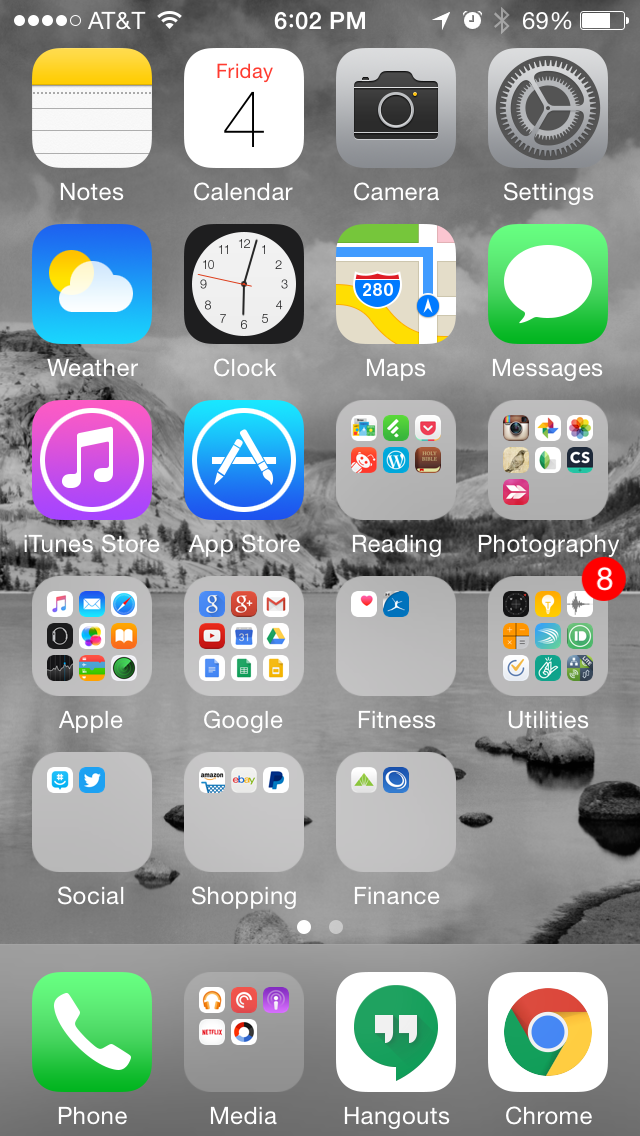
In case you are interesting in seeing my setup, see my 1st homescreen below (it’s the only one that matters, the other page only has 2 apps on it with no folders):
Android app permissions can be daunting and somewhat terrifying when you look at them. It can leave us wondering why does a calculator app need access to my microphone or contacts list. I hope that this post can put your mind at ease when installing a new app from the Play Store.
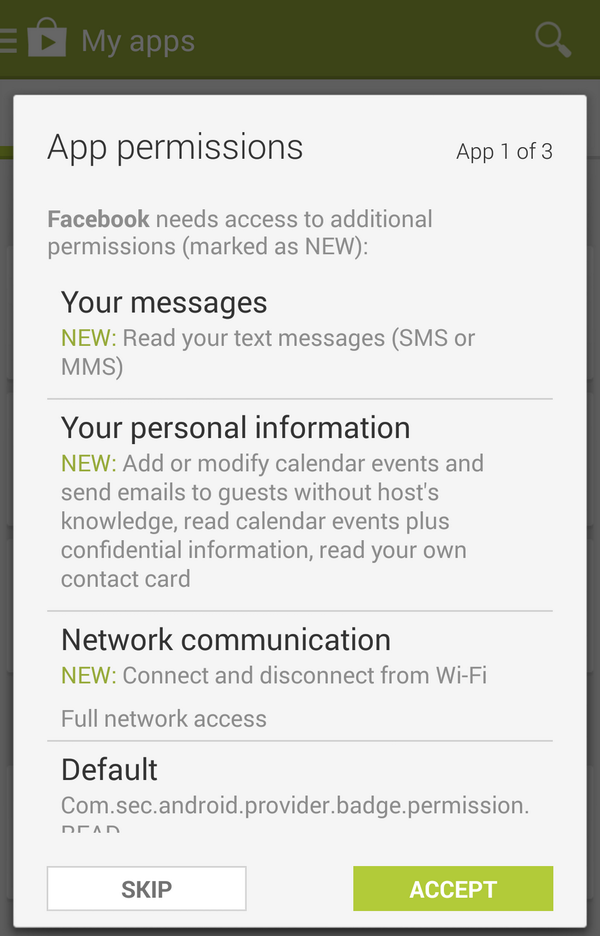
Here is an example showing the notorious Facebook app permissions below:
There is a legitimate reason that apps need access to certain hardware and list items of your device let’s break it down.
Why would an app need access to your:
Messages?
Some apps can push data directly to your SMS messages (eg. Inserting a link), without this functionality, it could make some apps far less useful.
Camera?
Perhaps you’d like to take a picture and push it straight into the app? Instagram, Hangouts and many other popular apps need this permission.
Contact list?
Apps can traverse through your contacts and see others that have that app installed and allow you to communicate with them. (eg. Snapchat). This will allow you to communicate with people that you know, just in a different way.
Storage?
Saving things to your device can be vital, this doesn’t mean that the app will read all of the contents of your ROM (if it did you’d know because it would be accessing it for some time).
Network?
If the app uses data for any type of transfer (eg. Loading lists, pictures, sending items, etc) the app will need to use your mobile or Wi-fi data.
Calendar?
In some cases you may want to export an event to your calendar. In the example above you notice that Facebook utilizes this.
Microphone?
No, your phone is not listening to you all the time. But I bet you like dictating text messages instead of tapping away while driving. Or you like to be able to do voice conferences with video.
In conclusion, although we ask ourselves why does an app need so many permissions when they utilize them to the fullest and make the app just work. In the upcoming Android 6.0 (Marshmallow) release users will be able to restrict certain permissions so if you don’t want your text message app using your microphone, disable it. Just don’t expect to dictate a message until you turn it back on!
Apps need permissions and all apps are not out to get you, especially ones that are available in the Play Store. Stay safe and watch apks that are downloaded from untrusted sources — those could harm your device; however, when it is obtained from a safe source, the app will work as designed and use the permissions as needed.
Bottom line: Don’t freak out about this stuff, your apps need these permissions to work the way they do. Removing them will only hamper your experience.
Tech for the masses, meant to empower, educate and inform by Dexter Johnson.


 DexJohn's PC