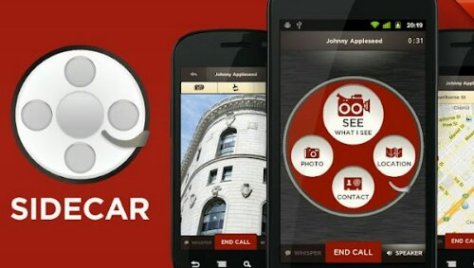
Voice over IP is evolving with an excellent gem of an app called Sidecar, which is available for Android and iOS devices.
Call quality as you might expect is not better than that of you carrier by any means. On the other hand, it is very good for a Wi-Fi connection; in fact there is an option to increase the quality of the audio, which will use more data. Reviews for the application for Android have came together to form a solid 3.7, which says that although the app is good there is room for improvement.
Aside from calling, users can share video, short messages, and more.
Bottom line: This app is a must have and it really shows the future that is in the palm of technology’s hand. Sidecar will only get better; be that early adopter.
4G, perhaps this term regarding advanced wireless technologies, was first used by Verizon with the mention of the 4G LTE service. Now, it seems that every carrier under the sun claims to have “blazing” 4G speeds and the “largest” 4G network.
Apple has been in headlines recently due to the company advertising that the new iPad has 4G data. The same is true for the iPhone in which a software update brought forth the appearance of 4G on the display screen; when in fact the iPhone is incapable of achieving 4G speeds when it has no 4G radios.
Is the Cupertino behemoth the only company falsifying data speeds? Surely not. The line between 3G, 4G, Wi-Max, and HSPA+ have been blurred for the past year. Cell phone makers carriers alike need to make the distinction between the different speed thresholds because sooner or later customers will realize that their device’s promised speeds will never be met.
Bottom line: The entire marketplace is a lie. Carriers and hardware manufacturers must differentiate data speeds. Honestly, consumers are getting sick of term after term. In the end, the only thing they want is performance.
These past few months have riddled the technological world with court case after court case. The strange thing is that Google seems to be in the middle of almost every lawsuit. Why? Here is the breakdown — Android is an open-source operating system built for smartphones. Not only has the Android platform appealed to many users it has appealed to so many that they are shaking up things in the smartphone market and it is making manufacturers and developers upset. So, what do you do when another company innovates faster and more than you?
Innovate and try to become better? No, you take them to court and try to stop their products from being sold.
Oracle claims that Google is infringing on copyright after copyright. Since Android itself is open-source they have used similar lines of code that are allegedly Java-related. The biggest retort from Google is that they did not realize that you could copyright a programming language.
This is equal to the “creator” of the modern English language to sue a man for writing a book that contains certain words and phrases.
Bottom line: It appears that everyone wants a piece of the pie. Just because an entity is open does not mean that it is always stealing from ones that are not. Oracle has proven that Google has infringed in certain areas leading to a partial verdict. Read more [HERE]
Adobe, the pinnacle company of media creation and editing, has done it again with CS6. This company has done a fantastic job with new versions of Premiere Pro, After Effects, Photoshop, Illustrator and more. CS6 excels in many areas such as:
Speed
UI Design
New advanced tools such as video editing
PC Mag did an excellent review of Adobe Photoshop CS6 [HERE], which is a remarkable piece of software, but winced at the fact that it did not support iCloud. With all of the great things that Photoshop does so well, to think they would pick out this nit-picky “con” about the software. iCloud is a service for users who are completely encompassed in the Apple ecosystem and to be honest there are far more users that aren’t that are. Not having iCloud integration is the least of Adobe’s worries and if I were over the development team I would be in no rush to bring such a proprietary feature to the list.
Watch an introduction to Photoshop CS6:
Bottom line: CS6 is the best in the collection of programs yet; definitely worth the upgrade.
Microsoft is really simplifying things this go-around and they are certainly making me proud. Not only is this a very anticipated release of Windows; it is rightfully so. Windows 8 will come in the following versions:
Windows 8
Windows 8 Pro
Windows RT – for tablet devices; will come pre-installed and will not be available for direct purchase
All of the versions will have the metro interface (Windows RT will be limited to just metro) and will be able to run all metro apps. However, Windows 8 and 8 Pro will be limited to the desktop users that require use of the traditional desktop and metro to complete one powerful experience.
Not only does Windows 8 offer a lot of promise for the consumer; it almost offers more for enterprise. This is a REAL tablet that corporations have been waiting for — not some toy like Apple’s iPad. This will put a solution in corporate America’s hand that will allow it to run legitimate software on a mobile device, not just some fancy app with a work-around.
Bottom line: Microsoft will not fail with this release; expect great things from Redmond this year.
Tech for the masses, meant to empower, educate and inform by Dexter Johnson.


 DexJohn's PC