It’s never a good thing to suspect that a company, especially one as large, controlling and expansive as Apple, could be doing something nefarious. This certainly is not the case, Apple is not doing anything to make consumers purchase new devices or give up on their old ones. However, what they did do, in traditional Apple fashion, is lack tact in delivering information to consumers, who just so happen to be the ones making them billions.
What is happening?
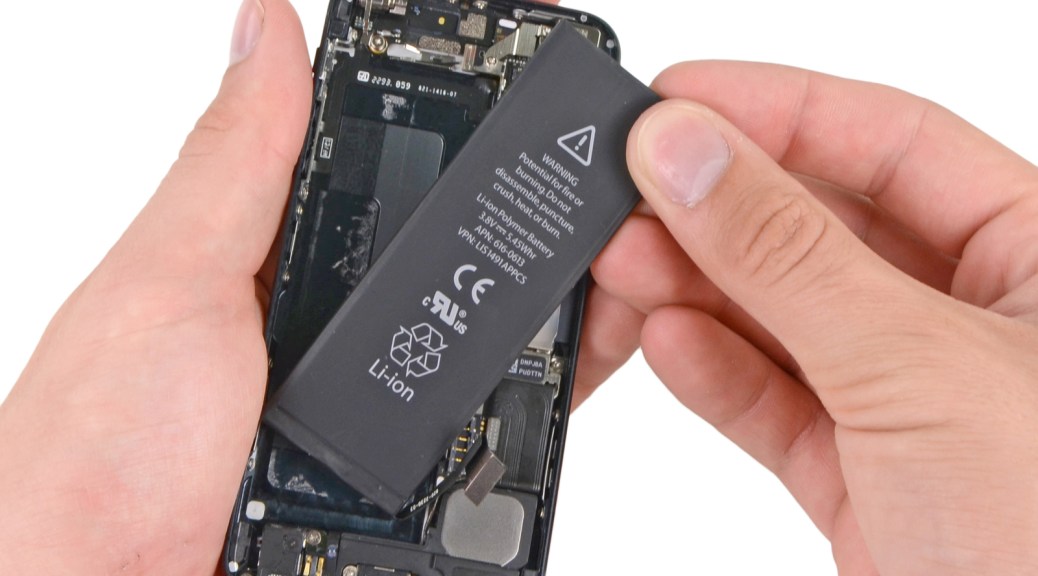
Over time lithium-ion batteries degrade. It has become common knowledge that your smartphone battery (any rechargeable battery for that fact) will hold less and less change as it only has a lifetime of so many charge cycles. With that being said, given the fact that your smartphone battery has limited life, develops wear and tear and will hold less and less charge over time it might make sense to slow an older phone down, right? Smartphone apps are not getting any less demanding nor are the mobile operating systems that contain them.
Due to the systems and applications that are on our mobile computers needing such power, they simply strain the battery too much for them to remain properly functional, meaning that Apple will throttle the performance of your CPU when it detects that the battery has a certain level of wear. When CPU spikes occur, sometimes we feel our phones getting hot (it simply means that it’s working hard under load); however, when you’re dealing with sensitive internals of a device — if your battery already a tremendous amount of wear, spike after spike of the CPU could have your device shutting off because it simply cannot handle the operations (we’ve seen this on iPhone 6), have it’s battery life plummet or worse, mechanical failure of the internal components. Users noted that after they got a battery replacement on their device it seemed to function normally presumably because no throttling was needed at that point because the battery in the device was of good integrity.
Remember the Galaxy Note 7? You don’t want mechanical failures like that in your precious iPhone.
Apple’s Response
Since the fallout, Apple has publicly acknowledged that this was happening and reportedly has been occurring since the iOS 10.2.1 update when it was noted that the iPhone 6 battery issues had been resolved. This comes as somewhat of a surprise to Apple loyalists when some enthusiasts have been suspecting Apple of “planned obsolescence” or intentional slowdown of older devices in order to get the user to purchase a new one. Additionally, Apple has noted that a future software update will give users insight into the health of their battery, this will come in early 2018.
My unbiased opinion
The issue that I have is that Apple did not tell customers that this CPU throttling was happening and honestly, they have a right to know, especially with newer phones costing $1000 and more. Don’t just sit back and apologize for Apple (or any technological company) over and over again when they make a mistake — this is wrong and cowardly when you hold such a compelling grip on your customers and can lead to consumer backlash. Perhaps that’s exactly what the company needs to stop being so secretive and oftentimes ignoring what their customers want and think.
Short story here, it’s an iPhone people. It’s an iPhone. But this isn’t necessarily a bad thing.
Design
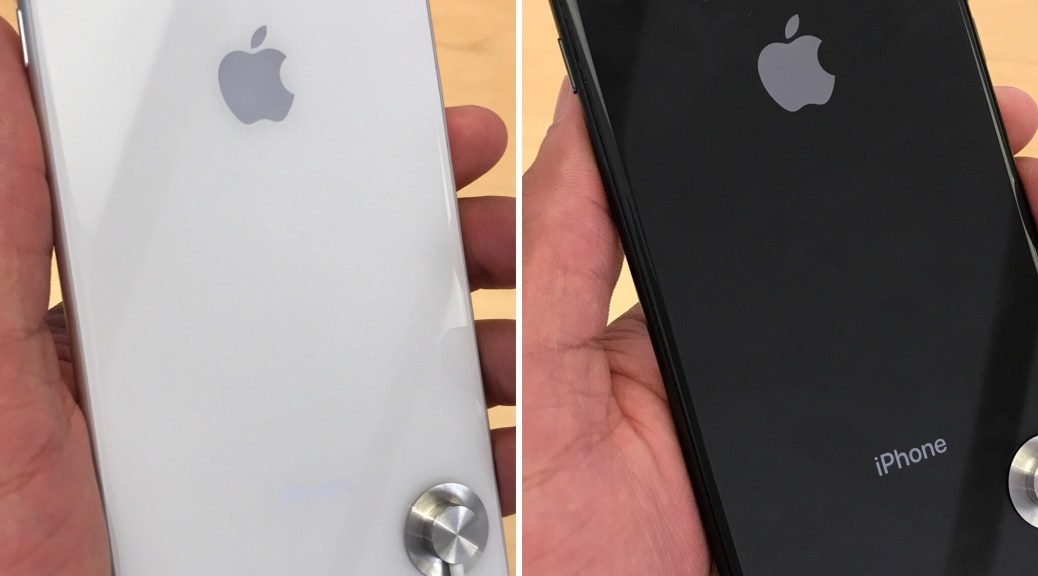
The design of iPhone 8 and 8 Plus is largely unchanged from it’s predecessor, maintaining a familiar body, weight and style even allowing for previous generation cases to fit perfectly on the new devices. Immediately upon picking up the device you notice the glass back, allowing for inductive (not wireless) charging, giving the phone a slightly grippier feel compared to that of iPhones 7 and 7 Plus as well as further hiding antenna lines commonly found on mobile devices.
The glass back truly brings in “peak” iPhone design.
Features
First off, don’t let anyone tell you that the newest devices from Apple aren’t worth your attention, sure they look similar, but internally there are changes throughout. From finally adding QI “Wireless” charging, the new A11 Bionic SoC and new camera specs — we’ve got a true update on our hands.
Should I Buy It?
Question of the day. If you’re coming from iPhone 6 or 6S (either model), there is NO question here — open the Apple Store app or go to your closest store and buy one of these phones. If you have an iPhone 7 or 7 Plus, you may want to reconsider. Could you upgrade? Yes, and I surely won’t stop you from handing Apple your money, however with the 7 still being extremely capable — just use your best judgement.
Overall
It’s a good device. Apple delivers year over year some of the most refined and consistent devices, iPhones 8 and 8 Plus are no different.
Anyone seen the roadrunner? Of course, you haven’t, because it’s on my wrist. The biggest upgrade with the Apple Watch Series 3 is it’s responsiveness and battery life improvements.
Overview
Coming from the original Apple Watch (lovingly known as Series 0), the speed increase is huge with Series 3 with GPS. Not only is the hardware much improved internally, watch OS 4 brings out the best in it. From an improved workout app, Siri on board and a carousel of complications — this is a solid upgrade. It is also reported that the speed increase is even notable from Series 1 and Series 2.
Speed
Speed increases are the biggest and best thing about the new Series 3 watch and is seen from the moment you raise your wrist from the moment you lower it. Even the most mundane and simple tasks such as swiping from watchface to watchface, opening an app and more — say goodbye to frame drops and hello to a perfectly smooth smartwatch experience.
watch OS 4
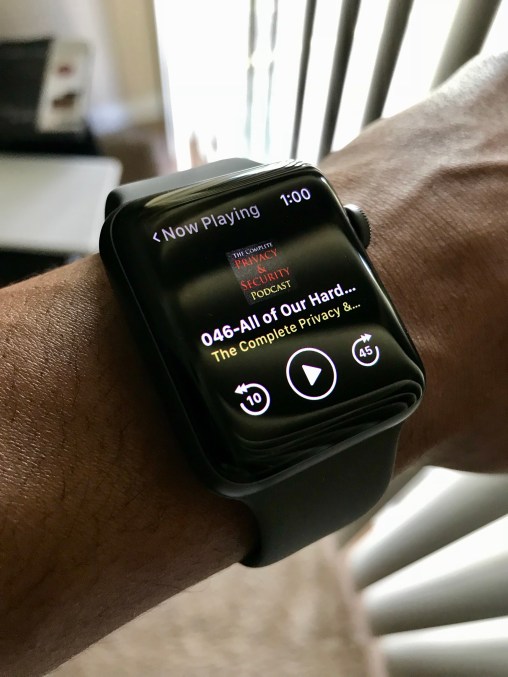
What does watch OS 4 bring to the table besides the very useful “Now Playing” complication? First off, Now Playing is an excellent addition and automatically puts your media front and center on your watch when there is something playing on the iPhone, just makes sense.
PocketCasts app shown above. The Now Playing screen is similar and accommodates to media coming from your iPhone.
With Siri here, she can actually respond to you with her voice, which is only due to the new processor in the Series 3 device. Apple Watch is an industry leading fitness device and the OS upgrade brings updates to the Workout app with more workouts to choose from an integration into new machines that will be coming to a gym near you.
Battery Life
Unbelievable. The upgrade from Series 0 to Series 3 is massive in this respect. Since purchase, I’ve gone to sleep after having it off of the charger all day with the battery at 84% and woke up with the battery at 77% — that is with light to moderate use the previous day. Just note that if this was my Series 0 it would’ve bit the dust overnight….
TLDR
Apple Watch Series 3 with GPS or with GPS and LTE are both considerable updates to the Apple Watch line and highly suggested if you’re in the market for a new wearable device.
Last week Apple announced a flurry of revisions and updates to it’s famed iPhone product line. Not only did we get updates to the iPhones 7 and 7 Plus, we got an all new $999 iPhone X (pronounced ten). Not only is the X a beautiful device (overall), it makes compromises left and right due to the choices, made by Apple, while now developers and users must pay the cost (literally) to use this new product.
Design
In an attempt to fully utilize the entire screen, iPhone X has two notches at the top of the screen that wrap around the Depth Sensor array and speaker at the top. Apple makes to attempt to hide this notch and creates two “ears at the top of the device that alters the experience unlike any other iOS device (more on that later). So while the screen at 5.8” is the largest screen ever on an iPhone, it will feel and react more like an elongated iPhone 7 or iPhone 8, not a Plus due to resolution. Let that sink in.
Software
iOS is arguably the easiest and simplest mobile operating system to use and get acquainted with and the iPhone X, albeit polarizing, does not change that fact.
Usability
iPhone X changes the paradigm, completely, in regard to how the screen displays information. So, first off, Springboard, which is Apple’s homescreen “launcher” remains the same — but let’s dive into the specifics of the hardware notch containing the True Depth camera array. This notch throws a wrench into a normally beautiful viewing experience and is considered by my technologists in the industry a design flaw, myself included. The issue this creates is that developers have to take into account this notch for all of their apps. Do they code around it? Or do they black out both “ears” surrounding the notch and just completely disregard that space? (Option number 2 is not recommended by Apple) So, will we enter an era of screen elements potentially ending up is strange positions around this hardware notch? You bet we will.
Additionally, this brings to light Apple’s claim to being edge to edge. Does it really count in this case? I’ll say that it does, but only because I’m trying to be nice. There are other phones on the market that still give us edge to edge but still have a small bezel around the device, look at LG V30. My question here is why couldn’t Apple push the sensors in the array further up, then give us equal parts of minimal bezel at the top and bottom of the screen? THAT would’ve worked…..
Should you buy it?
This is the tricky part, if you are using an iPhone 6 or 6s — go for it, if you can deal with a first generation product (not the first iPhone but the first in a brand new design). Value or worth is completely subjective to the person that’s willing to swipe their precious card — $1000 is a lot for a smartphone (Apple, Google and Samsung); however, when thinking realistically we use and rely on our smartphone more than any other computer we own. We want it to always have power, look nice, keep us in contact with friends and family — at the end of the day, the phone just needs to be worth the price tag.
The answer to this question is solely resting upon the shoulders of the buyer.
This has been a long year of leaks and speculation about Apple’s latest iPhone and other devices that are released in the fall. As usual, whether you have them or love them, the world has been on edge for what our friends in Cupertino are going to do and what all will be released.
Will it have a bezel? Will there be a mac Mini? Will it have wireless charging? How much is it going to cost?
Your questions and more were answered on September 12th 2017 — and let’s hope that all of the leaks didn’t spoil all of the goodies Apple had planned for us.
Steve Jobs Theater
Apple’s latest campus is one of the last things that Steve Jobs worked on, from detailing the type of trees that were needed and more. The Steve Jobs Theater was the place in which this fall Apple Event was to occur and as Tim Cook noted, “It was only fitting that Steve should open his theater” as we watched a very heartfelt video, seen below:
Source: cnet
This marks a great point in the history of Apple and it was no other way to start this event by words from a true visionary.
Apple Watch
Smartwatches, many of us have them; yet, many still do not. Some view them as a necessity, while others view them as a trivial child’s play thing — needless to say, the Apple Watch is the #1 selling watch on planet earth and touts the most used heart rate sensor of any device.
Let that soak in for a minute.
The Apple Watch has changed lives from making people fitter, more aware of their surroundings and saving a life or two, watch their stories here:
Source: Apple
Today, we met Apple Watch Series 3, one that’s faster and one that has built in LTE (plus GPS) so that you can make calls while you’re away from your iPhone. Usually phones get thicker when LTE radios and SIM cards are introduced (hello LG) — not this smartwatch. Apple has integrated the cellular antenna directly into the watch screen itself, while incorporating a tiny eSIM on board the device.
Now that the Apple Watch is faster, featuring it’s W3 chip — we now have Siri on board, but we already had that right? Now Siri can actually talk to you.
Source: Apple
Prices start at $329 for Series 3 with GPS and $399 with GPS + LTE
Apple TV 4K
Apple has made minor updates to the current Apple TV model and is introducing Apple TV 4K, bringing it inline with 4K content (albeit a small library) that is available today. The new Apple TV has an upgraded CPU in the A10X Fusion (same chip that’s in the iPad Pro) that is twice as fast as the old with a graphics processesor that is four times faster that the previous model.
Additionally, Apple is bringing 4K content to iTunes and all of your previous HD content that you’ve purchased will be automatically upgraded to 4K, free.
Source: cnet
iPhone
Let’s get to the star, or shall I say, stars of the show — shall we? For the past 10 years the iPhone has been an icon in the mobile space that has truly changed the world, from the way we interact, to the pictures we take, from the way we authenticate, how we consume apps, media and more — it is a truly iconic device. Today, Apple built upon that with 3 brand new smartphones to take us into the future.
iPhone 8 and iPhone 8 Plus (yup, skipped S this year) are our successors to iPhones 7 and 7 Plus from last year and there are upgrades brought to each model. Each device is now sandwiched between two very sturdy panes of glass, allowing for wireless charging — a first for an iPhone supporting the standard Qi, which means existing chargers made by Belkin, Spigen and others will work. Each device is color-matched to an areospace-grade aluminum bezel and are splash, water and dust resistant IP67 certified.
Top features:
New Retina HD display with True Tone (if you’ve used an iPad Pro, you’ve witnessed the greatness of True Tone, shifting to tone of the colors on the display based off of your current lighting situation — this is different from Auto Brightness)
A11 Bionic SoC with 6 cores featuring 2 performance cores and 4 efficiency cores, integrated with the first Apple designed GPU for up to 30% faster graphics performance than on previous models. The A11 Bionic is named “bionic” because of it’s “world tracking” and “scene recognition” abilities, making this vital for AR Kit, which is instantly the world’s largest augmented reality platform.
Updated Portrait Mode with new Portrait Lighting, which dynamically changes the lighting on the subject and provide a completely different feel to the photo all done while in the camera app itself
Updated speakers to be louder and deliver more bass
Bluetooth 5.0 enabling pairing of multiple devices at once
LTE Advanced
Source: Apple
Starting at $699 for iPhone 8 and $799 for iPhone 8 Plus at the 64 GB configuration, available for pre-order on 9/15 and available on 9/22.
But wait, there was one more thing…..
Meet iPhone X (ten), the future of the smartphone.
Source: Apple
The screen on the iPhone X stretches from top to bottom and features the same glass on the front and back as the iPhone 8 devices with the surrounding band made of surgical grade stainless steel, meeting the glass in immaculate fashion. Retina, move aside, iPhone X has an all new Super Retina Display that is 5.8″ diagonally with over 2.7 million pixels and has 458 PPI, the highest resolution ever put in an iPhone and it’s OLED. This is the first OLED display that has met Apple’s high standards to be placed into a device. Additionally notes is that the display features HDR, Dolby Vision, one million-to-one contrast ratio, color accuracy, 3D touch and True Tone.
But let’s talk camera…or cameras. The iPhone X features the dual camera system, which sports Optical Image Stabilization in each lens and now, Portrait Mode can be used on the front-facing camera as well.
Source: Pocketnow
Gesture Based Navigation
Since the iPhone X does away completely with the iconic home button of old, there has to be a way to get around the operating system. The home button is replaced with a thin bar that is accessible at the bottom of the screen at any time. With a series of swipe gestures you can get to where to need to go, quickly.
Swipe up — Home
Swipe up and hold — Multitasking
Source: cnet
Face ID
A whole new way to unlock your device, which is actually more secure than Touch ID. Let’s clear something up here, Face ID is NOT just your ordinary “Face Unlock” seen on phones in the past that essentially compare a picture of your face to what is seen in the viewfinder of the front-facing camera. The iPhone X features complex depth senors in Apple’s new “True Depth” camera sensor located at the top of the device’s display that actually analyze 30,000 invisible dots on your face — meaning that it really recognizes your face, really.
iPhone X depth sensors.
That is regardless if you change hairstyles, add glasses, add hats and more — your iPhone X still knows who you are on a new level.
iPhone X, Face ID — a technology that truly analyzes your face that replaces Touch ID on the latest high-end iPhone.
It’s a natural and effortless way to access your device that works even in the dark.
Features:
Easily setup
Specialized neural networks for your security
Face data protected by the secure enclave
On-device processing (not uploaded to Apple servers)
Requires user attention to unlock (eyes must be open and looking at the device)
1 in 1,000,000 chance of another user unlocking your iPhone X
Works with Apple Pay
Adapts over time
View all features and specs of the new iPhone X that I might’ve missed, here:
Source: Apple
Key Takeaways
After watching and reading about one of the biggest announcements, since iPhone — there is nothing to be underwhelmed about here and the iPhone X dominated the show, although it was the last item to be debuted. Apple Watch Series 3 has continued to build on the path set forth by it’s predecessor, while the Apple TV gained what the market wanted it to so badly have, 4K.
What are your thoughts on Apple’s latest announcement? Get involved and join the conversation, tweet me @Dexter_Johnson, I’ll be there waiting.
Tech for the masses, meant to empower, educate and inform by Dexter Johnson.




 DexJohn's PC