Tim Cook, Pharrell Williams and James Corden appear in a car singing their favorite tunes along with small talk about the new iPhone. They arrive at a door and Tim gets out and walks onto stage at the Bill Graham Civic Auditorium — and it begins.
Stats from Tim
Apple Music
Apple’s music service is noted to have reached 17 million total subscriptions and features numerous exclusives from various artists such as Drake and Frank Ocean.
App Store
Since it’s inception there have been 140 billion app downloads. The catalog contains approximately 500,000 games, making up the largest category on the App Store. This incredible figure makes the iPhone/iPad combination the largest gaming platform. Due to these feats by the iOS devices, Mario — that’s right — Mario, our favorite plumber will be gracing iOS with a new game entitled Super Mario Run!
Super Mario Run
This is the first time that a Mario game has been pushed officially by Nintendo to a mobile operating system and I’d easily say that they made the right choice by pushing it to the App Store. It is created with one-handed gaming in mind and features competitive features in the mode “Toad Rally”.
Education
ConnectED is a national initiative to bring technology to underserved students. With this Apple is working to donate iPads to 50K students. Additionally, we’ve seen updates to iWork with improvements in collaboration similar to other applications like Google Docs where the user can see additions made by other collaborators.
New Products
Apple Watch
The Apple Watch was second only to Rolex in the world for sales revenue in the year 2015 and is the top selling smartwatch overall.
Introducing Apple Watch Series 2.
With these impressive stats Apple has worked to produce Apple Watch Series 2 that is completely redesigned on the inside to provide water resistance. Additionally, the new wearable will be touting the Apple S2 processor, which garners faster app speeds on the device. This new mobile processor will also make it’s way to the first-generation Apple Watch, which will still be sold by the company. Furthermore, with the advent of the new Apple S2 processor, comes the new GPU that is 2x faster than the previous generation.
The display has been updated to be 2x brighter, blasting out pixel at 1000 nits (really bright, this is the brightest display that Apple has even put inside of one of it’s devices). With new processors built for speed the new drove of Apple Watch devices are poised to be great for new adopters.
Sport and fitness have been some of the highlight features of the Apple Watch and these alone have made it be one of the premier fitness trackers in the industry and with the introduction of GPS things are only going to get better (if the GPS feature is not something that you long for, opting for Series One is still a good idea or even the first-generation without the new processor if you can handle a device that is a tad slower). GPS tracking is a crucial feature for runners, cyclists and more who want a precise recap of the exact route that they followed. Apple has also partnered with Nike to create the Apple Watch Nike+. This specific model is similar to the Hermes Apple Watch that comes with a different band and a new watchface. The Nike+ watchface will provide a sporty interface in addition the watch will remind the user to run and get active.
The Series 2 device with an additional finish of ceramic will start at $369 and the updated Series 1 (first-generation Apple Watch) will be sold at $269.
iPhone
The Apple iPhone is the best selling product of it’s kind in the history of the world and has sold 1 billion units. Changes coming to iOS 10 include a newly redesigned Maps app that includes the ability to book rides and more directly from the app, changes to HomeKit, which is supported by virtually every major home automation product manufacturer, that are throughout the Home app that truly integrates home automation unlike any portal integrated into any mobile OS, changes to iMessage for more expression and tweaks and improvements that make this the fastest and best version of iOS to date. But with it has to come new hardware, right?
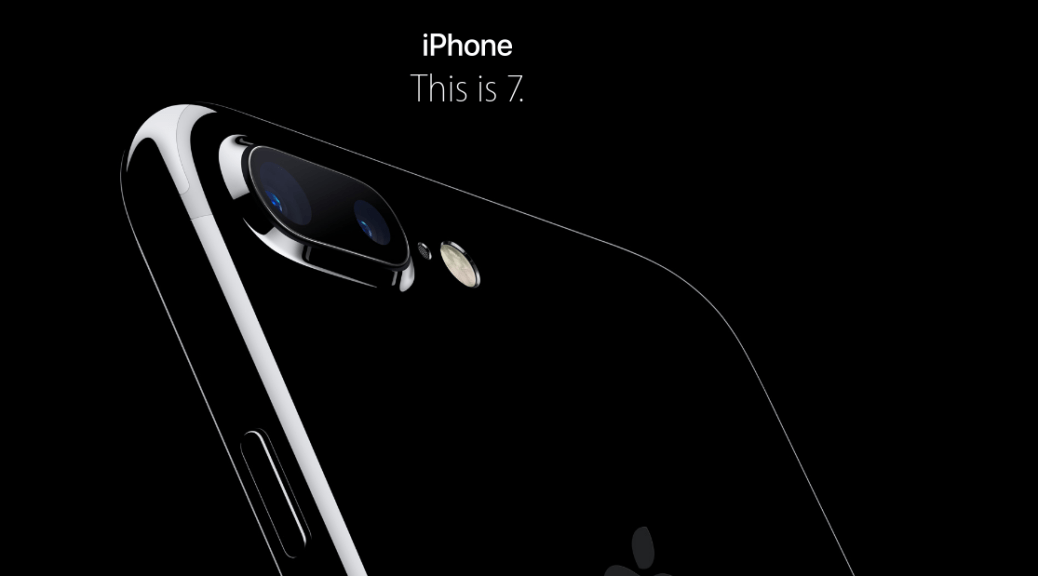
Introducing iPhone 7.
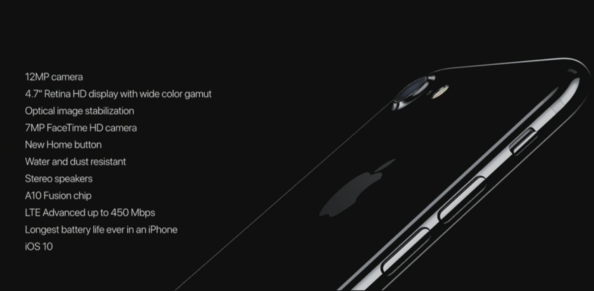
The iPhone 7 is coming to us with a slew of new features, which are detailed below:
All new jet black and black colors (Apple notes that the Jet Black color option may scratch easily and promote the use of a case)
Home button is changed from a physical button to a Force-touch button, similar to the trackpad on the MacBook and MacBook Pro line that works based off of the patented Taptic engine (see below, the removal of the headphone jack allows for this innovation)
Apple home button Taptic engine placement.
Water and dust resistant (IP67 certified) with gaskets throughout the housing
Camera features OIS on both 7 and 7 Plus models (additional camera features below)
F 1.8 aperture
6 element lens
12 MP sensor that is 60% faster than the previous model
Quad-LED true tone flash
Wide color gamut photos
RAW image capture
7 MP facetime HD camera
7 Plus features two 12 MP cameras, one wide-angle and another is telephoto so that the focal length can be manipulated and achieve the bokeh effect — these features will come as an update to iPhone 7 Plus users
iPhone 7 camera details.
Stereo speakers (one on top another on bottom)
Improvements to the Retina HD display that make it 25% brighter and support for a wide color gamut
No headphone jack, lightning ear pods are included (additionally a lightning to 3.5mm adapater comes with every iPhone 7 device)
Wireless AirPods, which feature the Apple W1 chip, are wireless buds that require one time setup and sync across all devices through iCloud
Apple’s new AirPods, starting at $159
Apple Pay support in Japan
Performance improvements through the newly design A10 Fusion chip, which is a 4 core 64-bit CPU that contains 2 high performance and 2 high efficiency cores (these can help save battery life when doing less intense tasks such as Email, calculator, light web-browsing and more)
A10 Fusion chip details.
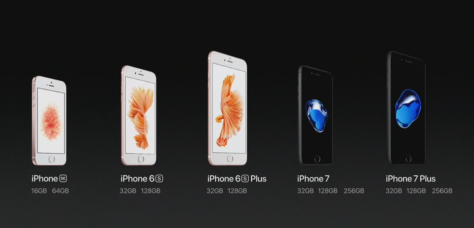
All of these features for the same price as the previous generation, with the addition of more storage. So, starting at $649 you will get the iPhone 7 models that come in either 32, 128 or 256GB configurations with these options replicating down to the existing iPhone 6S and 6S Plus. The iPhone 7 will be available for preorder on 9/9 and will ship on 9/16.
iPhone Storage Configurations
Bottom line and takeaways: This is a very solid announcement for Apple and a leap forward for the iPhone and Watch lines. The camera is certainly the biggest selling feature on this device and with pictures becoming more and more important in our lives — it should be a focalpoint. The removal of the headphone jack may make some upset, but it’s 2016 — get over it and use wireless devices. Why tether yourself to a device that is meant to be mobile? One note is that the AirPods are absolutely disgraceful — they are hideous, if you don’t get the point. One of the newly released pairs of Beats wireless headphones seem to be a better choice here. Additionally, revamping the home button is something much needed as that is the primary button on the device and it is known for collecting dust and sometimes becoming inoperable on older devices — this is huge.
Apple Watch Series 2 simply builds on the great foundation that was laid out by the first-generation device. Now with better waterproofing, a new ceramic case and a faster processor — these updates bring it into 2016 with a bang.
Of course with any update, this is the best iPhone to date, with better storage options, same pricing scheme, snappy A10 Fusion chip — what more could we ask for?
Let’s end with a quick hands on of the newly announced iPhone 7 and Apple Watch Series 2 devices below, Enjoy.
We’ve been waiting for an announcement that we knew was coming and it is now confirmed since the invites are out. The question is, is the cat out of the bag or does Apple have something up it’s sleeve at this point?
iPhone 7/7Plus
The iPhone has been a staple device in the lives on many for nearly 10 years and this year is no different. With subtle changes expected to be coming to the exterior and a new A10 chip powering it to make iOS even faster, this is surely going to be a spectacular decice. Additionally, rumors suggest that the iPhone 7 Plus model will contain a dual camera setup to be able to capture depth information similar to that of modern DSLR cameras — this is a big deal. A very big deal. Lastly, let’s talk about the elephant in the room….the lack of a headphone jack. Sorry kids, this is nothing to write home about. Supposedly the device is shipping with wireless “air pods” instead of the cabled mess that you’d normally receive.
I will not miss the 3.5mm jack.
Preview iOS 10 here:
Mac
The bustle has been “new MacBook Pros, new MacBook Pros” since Apple’s WWDC event where they were not released to the surprise of many. According to many sources, Apple was waiting on the Kaby Lake processors from Intel. There should be large changes to the MacBook Pro line with faster processors and a new macOS Sierra to power them.
Preview macOS Sierra here:
Watch
Apple Watch 2 is the buzz. Thinner, lighter and a bigger battery should power watchOS 3. Take a look at highlights of watchOS 3 here here (Source: iMore).
Samsung’s latest flagship device is here, the bold and beautiful Galaxy Note 7 and I’ve had the chance to spend some time with it. Starting at $850 this is one of the best Android devices that money can buy. With that being said, I will break it apart and highlight the good, bad and potential pitfalls that I see in the device. We must remember, that no device is perfect, but it can be “perfect” for us.
Let’s get reviewing, shall we!?
Screen & Body
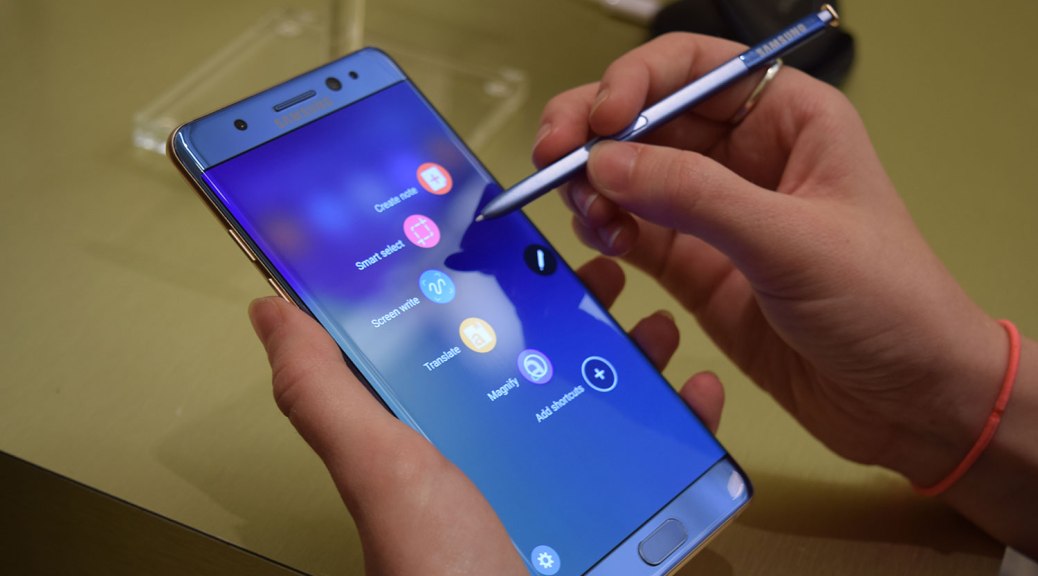
The first thing that you notice when you pick up the device is how sleek and sexy it is. Yes, devices can be sexy too! The curves on each side of the screen make it rest very well in the palm of your hands and does not appear to be too slippery without a case. Looking around the outside of the casing you can admire the variety of colors that it comes in: Black onyx, blue coral, silver and gold. In short, the blue coral is stunning to see in person — this version has a nice contrast with gold edges surrounding it while the black onyx color way follows up in a close second. When you press the power button, you are greeted by one of the best displays, if not best display, that is on a smartphone. This 5.7″ screen is packing a display at 1440 x 2560 pixels coming in with 518 PPI (pixel per inch) — this means the images you see on the device will be crystal clear with essentially no chance of you discerning pixels with your naked eye. The screen technology is Super AMOLED, which gives you very rich blacks and Samsung usually tweaks their displays to be a little more saturated than others on the market, which will make colors “pop” a little more than usual.
Galaxy Note 7, retail, in hand.
Camera Technology
Unless you’ve been living under a rock, you know that Samsung stuffs some of the best camera technology into a device and the Note 7 is no slouch here. The rear camera comes in at 12 MP with F1.7 aperture. The camera features optical image stabilization, RAW image capture, HDR (High Dynamic Range, just leave this setting on or at least on Auto) and more effects within the app itself. The front-facing camera is a respectable 5 MP shooter that can create a clear image and looks great through the on-screen viewfinder. Through the tests performed, shutter speed is quite fast (note: some Android devices struggle here, the Note 7 is more than capable of taking many pictures in succession). The only issue that could arise is if you are trying to quickly open the Samsung camera app quickly after closing another app, there were a few instances where it stuttered to open from memory; however, once open it performed like a charm. Saved pictures and video look fantastic on the 5.7″ display. Video is also smooth with OIS certainly aiding in any handheld shots that you get. Colors are very vibrant and make any image or video captured look fantastic. If a camera on a device is any driver for a purchase, then go ahead and get that credit card ready my friend.
User-Experience
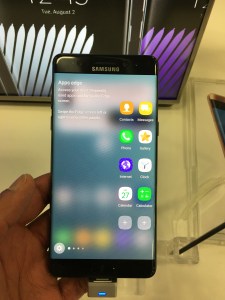
Samsung is calling the iteration of TouchWiz on the Note 7 “Grace UI” and for the most part it is graceful. Samsung has been scaling TouchWiz back more and more over recent years because of customer complaints and dreadful performance over time. Having a lighter user-interface makes the device perform quicker and usually those performance increases come with a lighter overall “weight” on the outward facing interface. Grace UI is light on it’s feet and light in colors that are easy on the eye. One of the best parts of the Note 7 and it’s UI are the built in “edge apps”. With a quick swipe in from the edge of the screen (can be repositioned in the settings) the user can access apps, contacts, news and more from a pull out on the edge of the screen. If any of you are familiar with the Android app SwipePad, think of it on steroids. Great innovation here by Samsung that makes the Note 7 experience that much better than another rival smartphone and can certainly help to drive the purchase decision — yes, they are that good.
Galaxy Note 7 displaying Apps Edge, which house many unique features to the Note 7.
The reason that we buy smartphones are to increase our productivity and applications built into the edges of the display do that and more. The S-Pen, as usual, is fantastic, easy to use and feels great once it hits the screen. Samsung has done a few good things here to ensure that S-Pen use is easy, from making it virtually impossible to put it in in reverse and making the screen detect it’s location mere millimeters away. All writing and drawing with the S-Pen is lag free and keeps you focused on the task at hand.
Another important part of the user experience is going from one app to another in our day to day lives and this smartphone gets the job done with minimal stutter, there is some to be found when opening certain memory-intensive games, opening the camera app, or swiping into Flipboard briefing (which is just awful and should be disabled) from the home-screen, which should be noted.
Take a look at this full review of the Note 7 from Android Authority:
Overall Impressions
Pros:
There are not many bad things that one can say about the Samsung Galaxy Note 7. The device is beautiful inside and out with power, grace (Grace UI) and plenty of features to keep you happy. If you are coming from a Galaxy S5, Note 4 or lower — I’d be confident to say that this is a must upgrade for you.
Cons:
The $850 price tag can serve as quite the significant barrier to entry for some buyers, especially with other high-performing Android smartphones like the Nexus 6P, One Plus 3 and others coming in at $400. Remember that this device comes with a lot of extra features that are useful — IF you make use of them. If you’re looking for just another “big screen device” you can get that elsewhere. Additionally, if you are looking for a lag free device, the Note 7 is not it. While Samsung’s latest flagship offers minimal lag, the weight of the skin and additional apps can show when opening the camera app or opening memory-intensive games.
Bottom line: If the Note series has a feature-set that you enjoy and you are due for an upgrade, this is a no brainier. With a camera, screen, companion apps and set of hardware specifications that are almost second to done, it’s easy to see why this device will sell. Additionally, if you’re just looking for a powerfully monstrous device that will last for years, look beautiful and perform with the best of them look no further — just be ready for your bank account to take a hit.
Google’s newest messaging and video chat platforms, Allo and Duo respectively are poised to potentially fail — hard.
Google has Hangouts already, which is almost a complete product;yet, they’ve invested time, development dollars and more on two new separate apps (that are end-to-end encrypted, by the the way). The company is also touting the fact that these apps are “specialized” with the fact that they do one thing. Certainly an interesting notion.
The real issue here is that Google is confusing consumers, they don’t know if they should use Messaging, Hangouts or the new combination of Allo and Duo. Furthermore, we certainly do not know what OEMs will include on the devices that they ship once these apps are live. Will they include the apps made my Google or will they make their own terrible emulations of them (cue Samsung)? THAT is the issue. We need clear direction of where Google and Android want to take messaging as it has been a mess for years with many consumers simply sticking to whatever app is thrown on their device.
With the rollout officially underway, download these from the Play Store or App Store when they are available and give them a try.
More and more we are witnessing opinion pieces regarding the state of Android and the fact that updates (or lack thereof) puts Google’s mobile operating system in a bad place. Here are the facts, if you do not have a Nexus branded device (a Nexus device is a consumer focused smartphone or tablet that Google partners with a OEM to create) you may not ever receive an update. Samsung was notoriously bad for withholding OS level updates, which increase security and performance, from it’s devices — it has gotten better and in most cases many of the more popular OEMs have gotten better at providing updates to it’s consumers. Android updates pictured visually.
Let’s break down the current statistics on the version of Android running “in the wild”, please note that these numbers are based off of devices that access the Google Play Store.
The question here is, “Do operating system updates matter to the end consumer?”. I will answer here bluntly — yes, a resounding yes. Anything that potentially has the means to improve security, performance and overall stability of a device for free — you as a consumer should care about and not push away as if it is so annoying that you cannot standby for 5 minutes without your device to install the update. One of the biggest issues is that the update process for most devices is painfully slow and arduous, partially due to carriers and partially due to the fact that OEMs continue to muck up the operating system with unneeded skins and apps that take away from the experience that Google has laid out by the reference device line — Nexus.
There is an interesting article on ZDNet that notes that “no one wants yearly Android releases” (find it here) that notes that the interest in updates has weakened. TLDR; no one cares about the updates, OEMs only want to sell devices, carriers care about you giving them money, developers want to sell apps and Google only cares about new devices accessing the Play Store (note these opinions come from the article and are NOT aligned with how I feel about the Android udpate issue). This is a fairly poor opinion to take on the system updates issue because it is clear that Google also wants consumers to be safe, hence why there are monthly security patches that are pushed out to devices. The problem? Only Nexus devices and the latest devices seem to adhere to this promise of the updates (even Samsung is getting better).
What about everyone else? Sorry my friends.
When it boils down to it, the update process on Android is seriously flawed, seriously. Google has tried to make it better; however, sadly, it is too little too late as this should’ve been properly thought of and scaled out during the beginning phases of the operating system.
Bottom line: If you want to have the latest version of Android either buy a Nexus device or always purchase the latest and greatest device. I will strongly argue that security, performance and stability are a must; however, it is clear that not everyone shares this opinion.
Tech for the masses, meant to empower, educate and inform by Dexter Johnson.







 DexJohn's PC