To-do lists, calendar apps all help you get things done and complete things on that worrisome epherial checklist. But that app or service you use will be different for everyone — is there a best? Maybe, maybe not.
Tests
I’ve used a handful of these apps over the years with TickTick, using Google login, for the longest. Additionally, I’ve have run-ins with Wunderlist as well which is simply bloated and not beautiful. An app should be functional, easy to use and easy on the eyes.
Enter Reminders for iOS…
Usage
Reminders is not just a reminder app, it’s for maintaining to-do lists as well to keep your organized. Any tasks or item can have a “Due Date”, which will force it into the composite “Scheduled” list on the day that the item is due. Additionally, look and feel of the stock app is heads over heels better than most third party devices. With lists that look like lists and an interface, which looks extremely open and useful — the end user gets a great experience.
Bottom line: If you haven’t found the “right” to-do app, give Reminders a try — it’s been right there all along.
APPLE!! This is your fault. You’ve started a terrible trend in smartphones and you need to fix it because as of Mobile World Congress it has officially gotten out of control.
Background
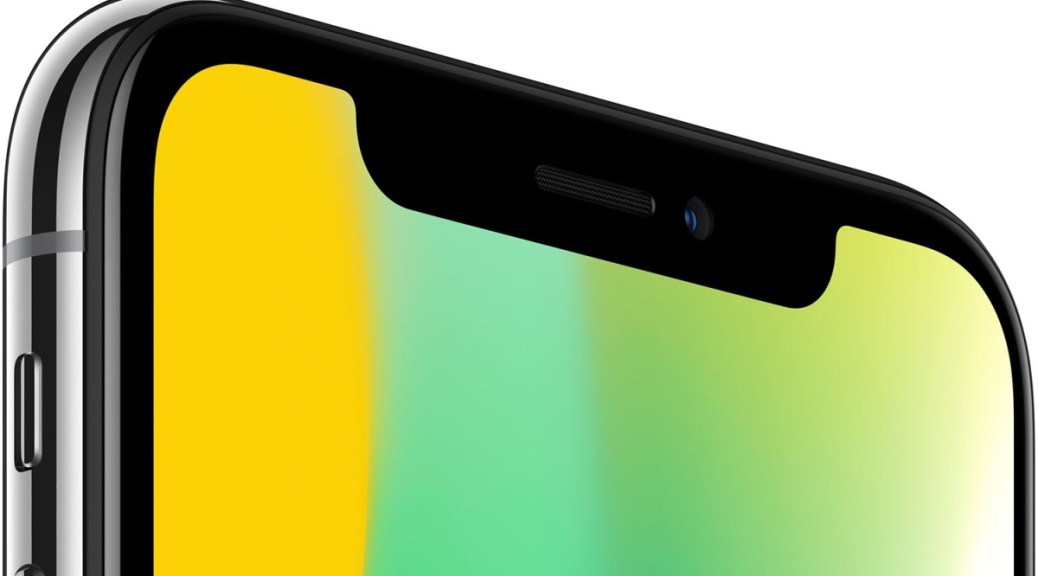
iPhone X was released last year with the promise of a full screen experience, although it’s clearly a pipe dream because the screen is interrupted because of a notch that houses the device’s True Depth camera system. Many Apple apologists claim that this notch disappears, while it mostly does, it’s still unsightly and calling it a feature is just being tone-deaf to the market. No one asked for a display that wraps around a component of the device. We want larger screens, however — why should developers have to pay the cost of having a screen larger than the iPhone Plus devices with LESS usable screen real estate because of the rounded corners and ears to the left and right of the notch?
Needless to say, it’s not pretty, functional or winning any design awards from DexJohn’s PC. In the case of edge to edge screens, while maximizing screen size….Samsung with the Infinity Display did it right, not Apple.
Fast forward
In walks every Android OEM that loves to copy Apple without reason. Some even tout that the notch on their device is smaller! But once again, who asked for it?
No one.
Although the decision to make a notch on the display is ill-advised, Apple at least does it for a reason — facial recognition. Android device makers and Google have not yet “cracked the code” on this tech, so at this point you’re copying to copy and not introducing anything new or better than the original flawed and uninspired design from Apple.
All in all, it needs to stop. These screen notches are a problem for apps, developers and end users (whether they realize it or not) and they are just plain stupid looking.
It’s that time of the year, Mobile World Congress 2018 and Samsung releasing another device to take the mobile world by storm — or will it?
Quick Thoughts
The Galaxy S9 and S9 Plus look stunning and carry over essentially all of the outside features from the S8 and S8 Plus, except the camera is reportedly improved and the fingerprint sensor is under the camera lens system this year, which is where it should have been since this design was drafted last year (way to backtrack Samsung). Hardware is something that Samsung has been getting right for years now and it should come as no surprise to anyone that this thing looks solid as a rock.
Expect the normal array of colors with an all new Lilac Purple version upon release. The display is still beautiful, as should be expected from Samsung with it’s patented Infinity display, which happens to look better than the iPhone X’s ugly notch, sorry.
Photo: Samsung Galaxy S9 Plus
Camera
Let’s talk about the major change in the 2018 device, the camera. And it’s not just your regular camera, it is one that can shoot in multiple apertures, which is notable because smartphone cameras are usually fixed; which could lead some shots appearing soft — well Samsung aims to fix that this year — hands on tests will tell. The amazing part is that when taking pictures, you can see the lens shifting to a different apertures to capture images in, which is perfect for light and dark shots — being more narrow in increased light and opening up more in low light. It is notable and impressive that this is the widest aperture (f 1.5) ever included in a smartphone.
Lastly, AR Emoji, which utilizes the front-facing camera, allowing you to take a picture of yourself and creating a lifelike emoji of yourself that you can send to your friends. Just like Animoji on iPhone X before, I wonder how many days it’ll take new Galaxy S9 owners to forget about.
Services
Smartthings and Samsung Health. We’ve seen how the health apps work, and Samsung is stepping it up this year with sensors to help check blood pressure. Camera integrations with Bixby to let you scan in foods and log caloric data into the Health app. Additionally, with Smartthings, which is huge for those who are integrating connected devices in their lives, will be baked right in.
Check out a condensed version of the S9 event below:
Source: The Verge
Final Thoughts
You should be very impressed with this device. The hardware is essentially flawless now with an improved camera, which was already one of the best. However, the only thing that could hamper the experience would be Samsung’s version of Android and how it will hold up over time.
Hands on coming soon as this device will be hitting stores on March 16th!
For years we’ve had countless members of our government, primarily liberals, that have spoken out against our lackadaisical firearm laws in the United States. Not only do we have some of the weakest laws on the planet, we also have increased school shootings and acts of localized terror — irregardless of if current presidents agree on the terminology. It is truly a shame that citizens can easily obtain military grade weapons and use them on others. What’s even worse is that it is even more apparent that the NRA seems to be in the ears of half of our political system. Why? Money and power.
The looming question is that since we have technology creeping into every part of our lives — why aren’t there more technological controls on and around firearm safety?
Smart Guns?
Should smart guns ever be a thing? It’s been talked about and prototyped but it doesn’t seem that one of these things will ever see the light of day. Is it simply because it’ll disrupt a booming American industry? I think so.
So often are technologies put on display that wouldn’t even allow an operator, not considered the “owner” of the firearm, to discharge it without fingerprint authentication. However, as usual with big business being behind every aspect of American life — it would be a travesty to allow a company to come in and instantly make our great “‘MERICA’ safer. The NRA is a major driving force of why smart gun adoption is not growing in the United States, to think that an organization that things each citizen should have an entire militia at their disposal would want any gun.
I agree whole-heartedly. This is a conversation that should be had. It’s one thing to own a gun; however, if you’re not military — you don’t have the right to walk into a gun show or pawn shop and purchase an AR-15, it is absolutely asinine. The same logic applies that me, Dexter Johnson, being a Database Professional, can’t go buy surgical equipment — why? Simply because I am not a surgeon and I do not require those tools.
Technology literally fills every part of our lives and it is truly sad that certain groups are holding on to guns as if they are the mark of freedom, an ignorant statement that gets the story wrong consistently. Other countries do not have the mass shootings and gun related incidents that the US have because of steeper laws on the ownership and possession of firearms. Additionally, let’s stop changing the narrative that I hear on repeat, “people kill people” and “the person was mentally ill”. No one should make it considerably easier to commit murder and that’s what lackadaisical gun laws do and 30,000 gun related deaths (Source: CDC) in one year is not “ok”. As Barack Obama said, “We are not trying to take your guns away.” However, it is 2018 and we have fingerprint sensors, retina scanners, facial recognition technologies, AI and more that could be tied to a gun and built into it that not only could it only fire for a particular user, maybe, just maybe not fire at all if even aimed at a human.
Source: Motherboard, “Who Killed the Smart Gun?”
The largest issues here are when, not if — authentication on a firearm fails. Let’s not forget that. Does your iPhone unlock EVERY time you look at it or every time you place your finger on the fingerprint sensor? No. No technology is perfect; however, it works within a high enough percentile placing the acceptance rate at nearly 100%. This is the primary argument against smart guns. However, the same can be said about mechanical failures — they also happen without “smart” technology built in — yet, that conversation isn’t had.
Final Thoughts
Smart guns and an actual protections and trainings of the potential buyers, while not the only answers, can help bring down gun related incidents in the US, let’s just hope that our overly-conservative, NRA fearing administration can see that. For everyone else working with technology, let’s find a way to keep this story at the forefront of our minds because technology can help if allowed to.
Keep in mind, that I don’t talk just to hear myself, I’ve provided a link to fast stats at CDC so that you can see the numbers for yourself as well as explore other statistics that are for public consumption.
Easily one of the most aesthetic, beautiful smart speakers on the market.
Enter Apple HomePod.
Let’s start off by saying that Apple is marketing this as a device that is “speaker first”, meaning that they are aiming to provide a device that gives you excellent sound quality with a voice interface, which is controlled by Siri. That doesn’t necessarily make it a smart speaker right? Well, it sort of does, especially when you can control HomeKit devices, send iMessages and play music — all tell tale signs of smart speakers. So although Apple doesn’t want the comparisons — there will be and I’d argue that there should be and is, based off of what this device does.
Apple HomePod (white), pictured in Apple Store.
Background
Apple has noted that HomePod has been in development for 6 years. That being said, this product aims to mesh together the worlds of audio, smart assistants and more in a pint sized package.
Design
As I noted, the design of the Apple HomePod is nothing short of fantastic. It is a hefty, yet small speaker featuring a soft mesh outer covering housing the many speakers, tweeters and microphones crammed inside. There are two colors that HomePod comes in, white, which gets dirty quickly and space gray. When it comes to ports on the device — there are none, with the only thing coming from the HomePod is it’s power cable, which is of exceptionally high quality featuring a woven covering. Note that are no other ports on the device, no aux in, no USB, which should be fine for most, as we are moving to a predominately wireless world.
Sound
I was able to get in a solid test, standing fairly close and moving my head all around in a local Apple Store and I was thoroughly blown away. The key thing to remember about how this sounds is “sound separation”, a listener can literally hear all of the sounds coming from the speakers, every instrument, every differentiating aspect of the song is clear and very crisp. This is one of the biggest differences when comparing to a Google Home, which I currently own, or Amazon Alexa. Google Home in comparison sounds slightly muffled and sounds mesh together, while HomePod seems to produce the music in a very accurate way. However, when it comes to overall volume, the Google Home Max still takes the cake in this department — that thing is just loud with very good bass.
See a sound test below comparing the HomePod to other smart speakers as well as Sonos Play (which I believe has an edge over HomePod, with Google Home Max being louder but lacking the auidble clarity due to distortion at higher volumes):
On the other hand, the only sound that you can ask Siri for is for music from Apple Music. No Spotify, Pandora, Google Play Music, Tidal (laughs) or others unless you choose to AirPlay them, which somewhat takes the intuitiveness out of it. If I have to grab my phone, go to an audio source and Air Play that source to the HomePod — then what are we doing? It’s simply too much effort when voice is my supposed interface. In fact, to set the device up, you must have an iOS device running iOS 11.2.5. So all of the Android users that utilize Apple Music — you cannot setup this device.
Note: Since this review and hands-on was done in store, I was unable to test “Hey Siri” functionality.
Ecosystem
This device is heavily integrated into the Apple ecosystem and it’s thought process on devices and services you should have. With that being said, the lock-in here is huge with only Apple Music being at the forefront with no other alternatives even being available to control via voice unless you’re noting for it to move to the next track.
Privacy
Unfortunately, at this time, Siri cannot support multiple users. An example is that if you ask it to read personal details such as text messages and your notes, it will read those items off to anyone that issues the “Hey Siri” command to it. This is especially odd, since Apple touts this device as being very private and other Apple-centric analysts on podcasts are quoted as saying, “I’d never have a Google or Amazon speaker in my house due to privacy“. Siri can differentiate between voices on your iPhone, iPad and Apple Watch, but can’t on HomePod. This is a huge miss and being someone, who is privacy focused and someone who deletes my voice data weekly from Google Home, I understand the need for differentiation of voices on smart devices — yet this goes full circle to Siri not being that smart and the fact that there are multiple versions of Siri spread across Apple’s ecosystem. You have Siri on iPhone and iPad, which are identical, then you have the gimped versions on Apple Watch, Mac OS, Apple TV and finally HomePod. So let’s not talk about “privacy” (this is talking to you, Rene Ritchie from Vector) until Siri can stop being so fragmented across devices made by the same company. Additionally, HomePod doesn’t offer a mute switch for the microphone either, which is featured on Google Home and Amazon Echo devices — instead, you must ask Siri to mute the microphone using a command.
Overall
If you are engrossed in the Apple ecosystem and are in the market for a speaker that can deliver excellent sound quality, HomePod may be right for you. However, no product comes without it’s limitations, as Apple simply isn’t open to many other companies when it comes to HomeKit integrations or third party music platforms and if you’re accepting of that, this could be right for you. AirPlay 2, stereo pairing with other HomePod devices and other features are slated to be released to the devices later in 2018. Siri capabilities are quite a disappointment as Siri on your iPhone can do more than on the HomePod.
At the end of the day, if an only if you’re committed to everything Apple would I recommend this.
Tech for the masses, meant to empower, educate and inform by Dexter Johnson.







 DexJohn's PC