Quit whipping it out…..Android Wear is here!

Smartphones have become a staple in the typical “busy” person lifestyle.  These neat little devices help manage our contacts, calendars and ultimately our lives.  With such powerful peripherals at arms reach one cannot help but to pull their device out for a quick check.

What if you could reach in your pocket less?  What if you could receive notifications that keep you plugging throughout your day that are unobtrusive and don’t make you seem rude to people you may be talking to?

The day is here.

Android Wear was officially introduced at Google I/O 2014 and this platform is looking promising from the very beginning.  Android was essentially built around the premise of multitasking and notifications that allow you to get a glimpse inside of applications on your device without the constant need to open one up.  Android Wear gives you the ability to see all notifications on your wrist and take action on them.  This added convenience is certainly a game changer and the industry has taken notice.

Bottom line:  The perfect companion to your smartphone is here.  It is officially time to free your hands from your pockets and have notifications in your face that are easily managed and there when you need them.

Definite buy.  Get Android Wear [here].
Does Build Quality Matter?

Samsung, HTC, LG, Apple and other mobile device manufacturers promise us this and that regarding the quality of the new piece of technology that we’ve spent our hard-earned money on.  However, most importantly we want a device that will last the 2 years that most of us agree to have it when we sign the contract.  Apple is known for producing superb products when it comes to the build aspect (regardless of whether you are an iOS fan or not this holds true).

Build quality plays several important roles in how one views their device:

  • How the device feels in your hand
  • How well the device holds up to abuse

Bottom line: Ultimately, it is up to the consumer — there are many devices that all seem to find homes somewhere, so the choice is yours!

New ASUS Chromebox

The latest Chromebox from ASUS is bringing us techies a lot of excitement — rightfully so.

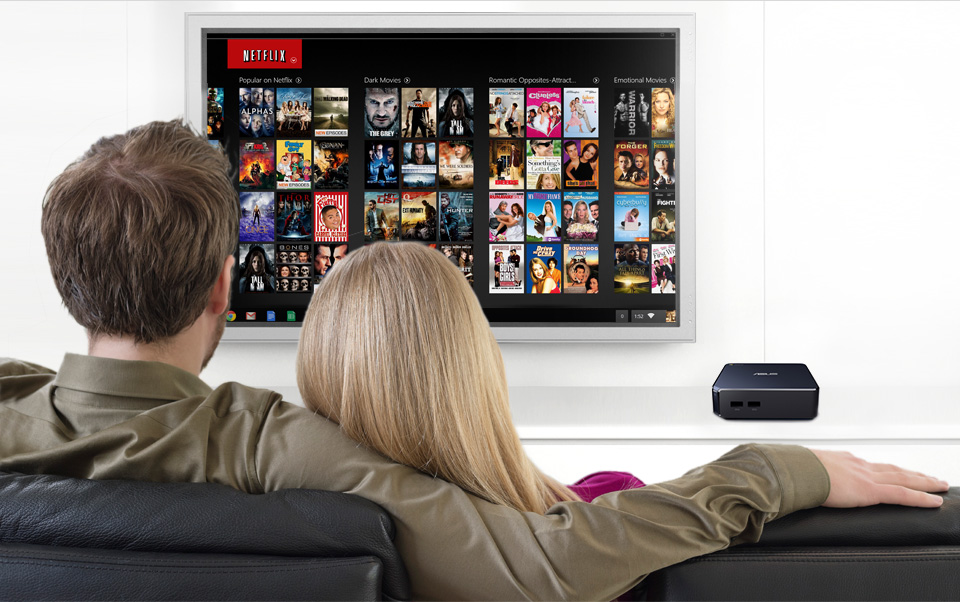
As a Chromebook owner, it is easy to see the delights and appeal of this friendly and easy to use OS (essentially Google Chrome with extensions and web apps) and see the power of having a small Chromebox (desktop version of the Chromebook) attached to a large display, such as your HD TV.

Couple watching media through the new ASUS Chromebox.

Think of the possibilities of having a desktop operating system on your TV. The entire internet will be right on front of you with no compromise. Google TV attempts to bridge the gap between an app ecosystem in Android and some say that it has not been successful.  As a Google TV owner, it is a great experience with a few shortcomings; however, this solution might be viable due to the ability to bring the entire Chrome ecosystem to your set.  Note, this is not the first Chromebox just the first Chromebox with this small form factor.

Bottom line:  Grab a wireless keyboard and mouse and you have a full entertainment system in front of your eyes.  This is definitely a step up from Google TV, which is missing critical apps such as Hulu Plus.

Innovation Gone Missing?

With the International CES (Consumer Electronics Show) coming to an end, many technologists feel like there is a lack of innovation and useful electronics that we “need”.  Or is this lack just a shifting of times where manufacturers would rather host their own events to reveal their latest products.

That certainly is the case with Google, Samsung and Apple.  None of which were present at this years CES show in Las Vegas, Nevada.  It is a rant that many products that are shown at CES never have the opportunity to come to market, which certainly is disappointing if you are going to see the latest and greatest in new technology.  One big space for this year has been flexible display panels, which may go the way of the 3D TV.

View some highlights below from YouTuber MKBHD:

4K Cameras:

Samsung Galaxy Note Pro & Tab Pro:

Battery Technology

Smartphones have become almost a necessity in this fast-paced, technology driven world that we are in.  Coming in a variety of screen sizes, storage capacities and shapes it is almost a smartphone for everyone.  Then you have your choice between Android and iOS devices, that is another argument altogether.

Let’s start off with the thing that you look at, the screen.  The display on a smartphone is the main component that drains battery life and it seems that every manufacturer places a “retina” display or Full HD display in their device.  Meanwhile, this is retaining the same battery technology from yesteryear.  In fact, there are rumors that Samsung is working to produce a 4K resolution handset.

That’s right 4K.

There is not even a significant amount of people who actually own 4K televisions, so where would you enjoy the content that you caputure from the 4K camera that will also be smashed into the device?  Only on your device.

Next, let’s break down processors that get faster and faster every year.  My first Android device, which was a Motorola Droid X, has a 1 GHz single-core processor — my current device, Nexus 4, is running a quad-core processor.  Although, mobile processors have advanced significantly over the years with battery saving technology built in — it still misses the point.  A bigger and better battery is still needed to push our devices with these larger screens containing more pixels all day.

Image

There is no one person that I know, who is a smartphone owner, that does not either have a car charger or have the need to charge their phone at some point throughout the day.  Owning the Nexus 4 has been great because I can go all day without charges; however, many suffer throughout their days with their phones almost always needing to be tied to a power outlet.

Bottom line:  Given the above information is factual, it appears that the technology placed in batteries needs to advance more along with the components that they are powering.  With a majority of high-end Android devices having 1080p screens, better batteries are a must to keep their owners content and the device being used to it’s full potential in many situations (eg. Until the device owner goes to bed).

Tech for the masses, meant to empower, educate and inform by Dexter Johnson.